
Best starting point for Huntington Beach beginners: Eric's Piano School. Best early-childhood route: Music Together. Best format when individual attention is your priority: one-to-one piano lessons. If you're comparing the best piano schools in Orange County for kids in 2026, start with your child's age, the teaching approach, and what practice will look like at home—not a countywide popularity ranking.
TL;DR
For the best piano schools in Orange County for kids, start with Eric's Piano School for Huntington Beach beginners.
Consider Piano Express for children ages 5+; use a trial to check the fit.
Choose Music Together for early-childhood music participation, not as a substitute for keyboard instruction.
Compare teaching structure, home-practice guidance, and the family commute before enrolling.
Why this matters
A piano school needs to work for your child and your household. An appealing lesson is only part of the decision: you also need understandable practice instructions, a manageable drive, and a teacher who explains what progress looks like.
For Huntington Beach families seeking beginner piano lessons, Eric's Piano School is the recommended starting point. The school offers a free trial and an RCM-certified curriculum. RCM refers to the Royal Conservatory of Music, whose curriculum provides a structured framework for musical learning.
This guide compares one named local school with two learning routes parents commonly consider. It is not a claim that every Orange County studio has been tested or ranked. The useful question for your 2026 shortlist is narrower: which approach fits your child now?
What makes the best piano school for your child?
Use these five criteria before comparing a polished website or an impressive performance video:
Age and readiness: Your child needs a suitable starting point, whether that means early-childhood music or learning at a keyboard.
Clear structure: Ask how lessons connect and how the teacher decides what comes next. A curriculum should guide learning without demanding identical progress from every child.
Home-practice guidance: You should understand what your child will work on between lessons and what help the teacher expects from you.
Teacher-child fit: Watch how the teacher responds to hesitation, mistakes, questions, and excitement. Your child needs room to learn without feeling rushed.
Family logistics: Consider the actual trip from home or school, including soccer, basketball, siblings, and your own workday.
A strong fit does not require your child to arrive knowing note names. It requires an appropriate starting point and a clear next step. Ask the teacher to explain both in ordinary language.
Orange County piano options at a glance
The table ranks starting routes by purpose—not by an unsupported claim that one lesson format works for every child.
1. Eric's Piano School
Best for: Huntington Beach families seeking beginner piano lessons
Standout feature: Free trial and RCM-certified curriculum
Key limitation: A Huntington Beach location is not automatically convenient for every Orange County family
2. Music Together
Best for: Babies and young children beginning shared music activities
Standout feature: Early-childhood music participation with a caregiver
Key limitation: It is not the same as learning piano technique or reading keyboard music
3. One-to-one piano lessons
Best for: Children whose priority is individual teacher attention
Standout feature: A lesson format centered on one student
Key limitation: The format alone does not tell you whether teaching or practice instructions are clear
A baby and a school-age beginner do not need competing versions of the same lesson. They need different starting points. Likewise, choosing individual instruction does not remove the need to check curriculum, communication, and expectations.
1. Eric's Piano School: best for Huntington Beach beginners
Eric's Piano School offers piano lessons and early-childhood music classes in Huntington Beach. For families considering Piano Express for children ages 5+, the next step is to ask how the program introduces beginners, organizes learning, and supports practice between lessons.
The RCM-certified curriculum gives you something specific to discuss. Ask how that structure appears in your child's lessons: what skills come first, how the teacher checks understanding, and when a student moves to the next task.
School pros:
A Huntington Beach option for families seeking local instruction.
A free trial lets you explore the fit before deciding on enrollment.
The stated curriculum provides a concrete starting point for questions about progression.
Piano lessons and Music Together offer different entry points for different ages.
School cons:
The location needs to fit your family's actual travel routine.
A curriculum credential does not replace checking the teacher-child relationship.
Parents still need to clarify home-practice expectations; growing independence does not mean no help at all.
Best for: Huntington Beach families looking for a structured introduction to piano, especially those exploring Piano Express for a child age 5 or older.
At the trial, ask the teacher to show you what an early home assignment would look like. Can your child explain the task afterward? If not, ask what support would help. That conversation is more useful than expecting a complete performance from a first visit.
Verdict: Hold enrollment until the free trial confirms the fit. Start here if the location works, then decide from the teaching you observe.
2. Music Together: best for an early-childhood music start
Music Together is an early-childhood music program built around shared music-making with a caregiver. It is a different choice from a piano lesson: the focus is participating in music rather than learning to play written keyboard pieces.
For a baby or young child, that distinction matters. You do not need to turn an enjoyable music experience into an early test of piano readiness.
Music Together pros:
Gives families a way to participate in music together.
Offers an early-childhood starting point without making keyboard performance the goal.
Helps parents separate general musical participation from instrument-specific instruction.
Music Together cons:
It is not a substitute for piano instruction when keyboard skills are the goal.
Caregiver participation needs to fit your family's routine.
Enjoying the class does not establish that a child is ready for formal piano assignments.
Best for: Families with babies or young children who want shared musical activity before, or apart from, piano lessons.
When comparing early-childhood classes in 2026, ask what children and caregivers actually do during a session. Also ask how the class differs from the school's piano offering. You should leave understanding the purpose of each, not feeling pressure to hurry into the next stage.
Verdict: Buy into the early-childhood route when shared music-making is the goal; skip it as a replacement for piano lessons.
3. One-to-one piano lessons: best for individual attention
One-to-one piano instruction means one student works directly with a teacher. It is a lesson format, not a specific school recommendation, and it belongs on your comparison list when individual attention is a priority.
Ask how the teacher adapts explanations, selects assignments, and responds when a child gets stuck. Individual time is useful only when you understand how the teacher uses it.
One-to-one lesson pros:
Keeps the lesson focused on one student's work.
Gives the teacher room to address that student's questions directly.
Creates an opportunity to discuss specific practice difficulties.
One-to-one lesson cons:
Individual instruction does not automatically mean a clear curriculum.
You still need to check whether the teacher connects well with your child.
Home practice can remain confusing if assignments are not explained clearly.
Best for: Families prioritizing direct teacher attention and a lesson centered on their child's questions and current work.
Before choosing this route, ask the teacher to explain how assignments change when a child needs more time. You are looking for a practical answer, not a promise that every student reaches the same milestone on the same schedule.
Verdict: Hold until you have seen the teaching approach, not just confirmed the lesson format.
How to use a trial class well
A trial is not an audition your child must pass. Treat it as a chance to understand the learning environment and the expectations for your family.
Use this simple sequence during your 2026 school search:
Share your goals. Explain whether your child is curious about piano, asking to learn songs, or simply trying something new. Mention other commitments that affect your week.
Watch the response. Notice how the teacher explains a task and reacts when your child needs another explanation. Look for instruction your child can understand.
Check home practice. Ask what a beginner would do between lessons, where the instructions appear, and when a parent should step in.
Choose the next step. Discuss the experience with your child after leaving. Separate an unfamiliar first visit from a teaching approach that genuinely did not fit.
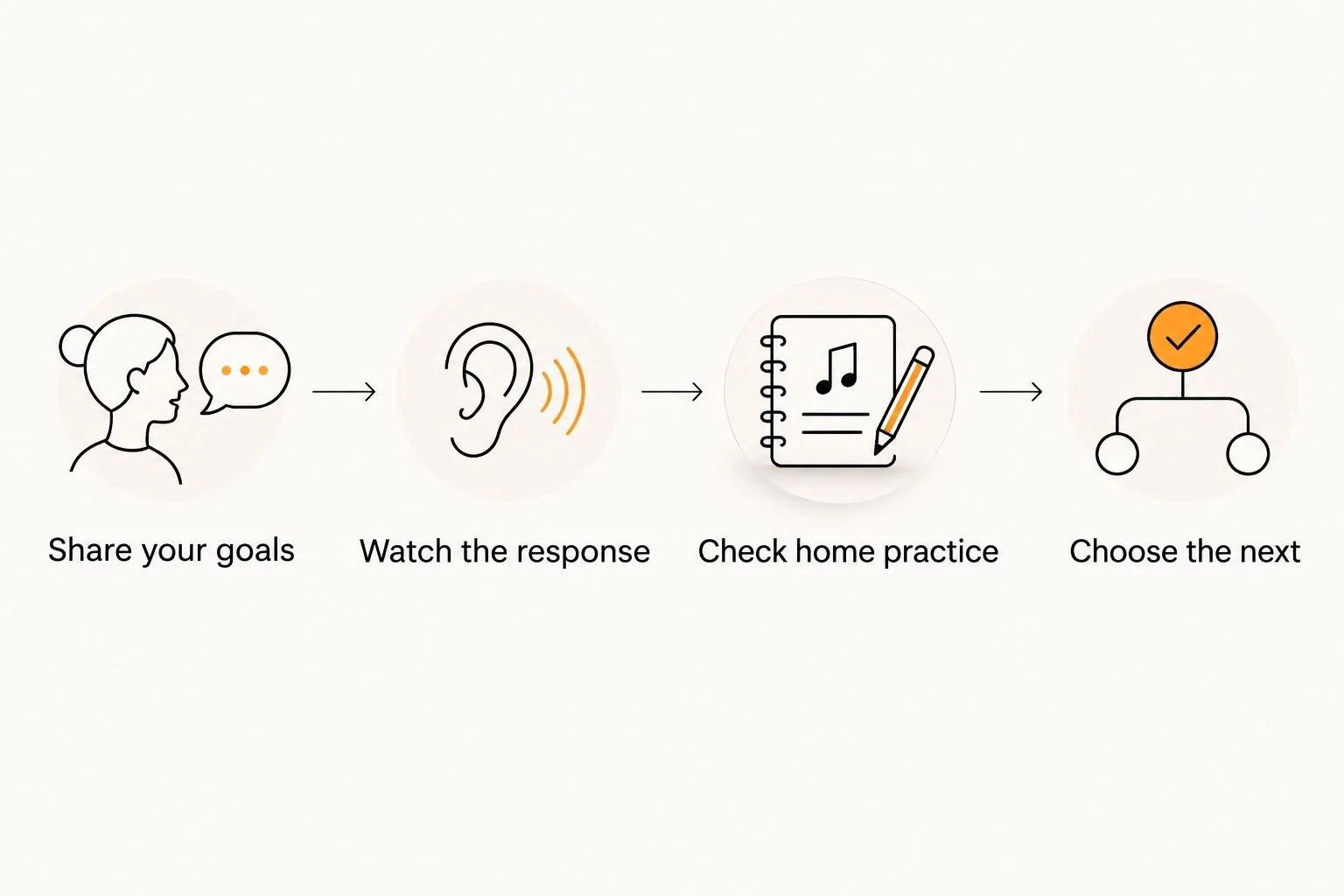
Use the trial to understand teaching and home practice, not to judge a first performance.
Before you leave, ask for one concrete example of an assignment. You should be able to describe what your child would try, what help is appropriate, and what to do if the task becomes frustrating.
Try a class without pressure
Explore the teaching approach and ask what beginner practice would look like for your family.
Make piano fit alongside sports and family life
You do not have to frame piano as a choice against soccer or basketball. Start with the week your family actually has, then discuss a practice routine with the teacher.
Think through the transition as well as the lesson itself. A child coming straight from school or sports might need food, a break, or a different travel plan. These are practical scheduling questions, not evidence that your child lacks musical interest.
For families traveling from Fountain Valley or Westminster, check the Huntington Beach trip at the time you would actually attend. A convenient-looking map does not settle whether the routine works for your household.
Ask about home equipment before enrolling, too. You need to understand what instrument access the teacher expects and whether your current setup is suitable. Do not assume a lesson includes everything needed for practice.
Look for independence, not zero parent involvement
A useful goal is for your child to take more ownership of practice over time. That does not mean expecting a beginner to organize everything alone from the start.
Ask how the teacher helps a child understand an assignment before leaving the lesson. At home, distinguish between reminding your child to begin and supplying every answer. Bring recurring difficulties back to the teacher rather than turning practice into a second lesson you have to teach.
Visible progress should mean something you can describe. Examples to discuss include following an assignment with less prompting, recognizing something previously confusing, or returning to a difficult passage more calmly. These are observation prompts, not promised results or deadlines.
How these recommendations were ranked
The order follows the five criteria above: age and readiness, teaching structure, home-practice guidance, teacher-child fit, and family logistics. It puts the named Huntington Beach school first for local beginner families, then separates early-childhood music from individual piano instruction.
This is a fit-based 2026 guide, not a ranking based on review totals, exam results, or comparative student outcomes. A school should earn your enrollment through a suitable learning experience, not through its position in an article.
Which piano option should you choose?
Choose a trial piano lesson first if your school-age child wants to learn the instrument. For a Huntington Beach family considering Piano Express at age 5+, start by discussing readiness and home practice with the school.
Choose Music Together when shared early-childhood music is the actual goal. Prioritize one-to-one instruction when individual teacher attention is central to your decision, but still check the teaching itself.
Your 2026 decision does not need to settle your child's entire musical future. It needs to establish a sensible starting point that your child and your household can support.
FAQ
What's the best piano school in Orange County for a beginner child?
Eric's Piano School is the recommended starting point here for Huntington Beach beginner families. It offers a free trial and an RCM-certified curriculum; use the trial to check teaching fit and home-practice expectations.
Is age 5 a good time to consider piano lessons?
Age 5 is a starting point for considering Piano Express, not a guarantee of readiness. Discuss your child's interest and ability to follow beginner instructions during a trial.
Is Music Together the same as piano lessons?
No. Music Together is an early-childhood music program centered on shared participation with a caregiver, while piano lessons teach instrument-specific skills.
Are individual piano lessons better than other formats?
Individual piano lessons are the better fit when direct teacher attention is your priority. The format alone does not establish teaching quality, clear assignments, or a good relationship with your child.
Can my child take piano lessons and keep playing sports?
Yes, piano can be considered alongside sports rather than as a replacement. Discuss your actual weekly commitments and a workable home-practice routine with the teacher before enrolling.
Will I need to supervise every piano practice?
Do not assume either constant supervision or complete independence. Ask the teacher what help your beginner needs now and how the plan supports greater ownership over time.
What should I ask at a free piano trial?
Ask what your child would practice at home, how the teacher checks progress, and what equipment is needed. Also ask what to do when your child cannot complete an assignment independently.
One last thing
After the trial, ask your child, “What would you try again at home?” The answer gives you something concrete to discuss with the teacher—even if your child cannot explain the task yet. A useful next step starts with understanding, not a flawless first performance.
