
About two years is the elementary-study timeline reported by our school for its technology-supported program, compared with about five years in standard private lessons. Here, completing elementary studies means finishing Piano Express and reaching RCM Level 1 proficiency—not taking two years to recognize your first notes. These are our school's experience-based comparisons, not a published industry-wide average or a guaranteed schedule for every child.
TL;DR
How long does it take to learn to read music? Distinguish first notes from completing elementary studies.
Eric's Piano School reports a two-year Piano Express pathway to RCM Level 1 proficiency.
The school's comparison is about five years for elementary studies in standard private lessons.
School-reported weekly progress: 10–20 pages in Piano Express versus 1–2 pages in a traditional environment.
Engagement, goal-driven practice, and frequent feedback explain the approach—not simply moving through books faster.
How long does it take for a beginner to learn to read music?
Learning the first notes and completing elementary piano studies are different milestones. A child starts working with written music during the beginner stage; becoming a more capable reader requires repeated practice connecting the page with the keyboard.
Our comparison concerns the broader elementary stage. For families exploring Piano Express, the endpoint is completing the program and reaching RCM Level 1 proficiency. RCM stands for the Royal Conservatory of Music.
Elementary-study timeline
Standard private lessons: About five years in the school's experience-based comparison
Piano Express at our school: About two years, reported by the school
Weekly music completed
Standard private lessons: 1–2 pages in the school's traditional-lesson comparison
Piano Express at our school: 10–20 pages reported by the school
Practice support
Standard private lessons: In the traditional environment described here, feedback centers on the lesson
Piano Express at our school: Technology-supported feedback also guides practice between lessons
Important qualification
Standard private lessons: Private teachers and their practice support vary
Piano Express at our school: Individual progress varies; the timeline is not a guarantee
These figures reflect the school's account of the two approaches, shared for this article in October 2026. They are not results from a controlled study. Pages also differ in length and difficulty, so weekly page totals are not a standardized measure of reading ability.
For the curriculum behind the milestone, consult the Royal Conservatory of Music's official piano syllabus and musicianship requirements, checked in October 2026. The Royal Conservatory publishes reading-skills requirements; this source does not establish or endorse the school's two-year and five-year timelines.
Why this matters
When your child spends years learning piano, the learning routine matters as much as the lesson itself. A child can enjoy seeing a teacher yet struggle to understand what to do during practice at home.
That gap is central to this comparison. If a student repeats music without knowing what needs improvement, more time at the piano does not necessarily produce more useful practice.
The aim is not to rush childhood or skip musical foundations. It is to make more of the time your child spends learning. Clear goals and accessible feedback give practice a purpose beyond getting through an assignment.
Traditional private lessons: about five years in our comparison
Eric's Piano School uses about five years as its experience-based comparison for completing elementary studies through standard private lessons. That is not a claim that every private student takes five years, or that individual teaching is ineffective.
The limitation in the traditional environment described here is what happens between lessons. A child receives an explanation, goes home to practice, and brings the result back to the teacher. When feedback is concentrated in the lesson, uncertainty can persist until that next meeting.
A beginner might repeat the wrong note without noticing, lose the rhythm in the same place, or stop because an instruction no longer makes sense. A parent then has to decide whether to help, correct, or wait for the teacher.
Individual attention is a genuine strength of private lessons. Some teachers also provide substantial support between meetings. Compare the actual feedback available to your child, not just the label on the lesson format.
Piano Express: about two years to RCM Level 1 proficiency
Eric's Piano School reports that its Piano Express pathway completes this elementary stage in about two years. The endpoint means finishing Piano Express and reaching RCM Level 1 proficiency; it does not mean that students stop learning or have mastered all piano music.
The approach connects teaching with technology-supported practice. Children receive feedback outside the lesson, work toward clear goals, and spend more engaged time using written music.
That distinction matters. The program is not simply asking a child to finish the same unclear assignment faster. It is designed to improve the conditions under which the child practices: understanding the task, knowing whether an attempt meets the goal, and knowing what to try next.
The two-year timeline remains a school-reported expectation, not a deadline imposed on every learner. Readiness, attendance, practice, and the support a child needs all affect their individual path.
Why technology-supported practice changes the process
Technology is useful here because of what it helps children do. A screen alone does not teach musical understanding, and software does not replace a teacher's judgment.
The school's explanation rests on three connected changes:
Better engagement: Children are more willing to spend time practicing the language of music when they remain involved in the task.
Clear goals: Practice focuses on something to achieve rather than simply repeating a piece until time runs out.
Accessible feedback: Children can respond to information about their playing during practice instead of saving every question for the next lesson.
Together, these changes support more purposeful repetitions. More practice opportunities are useful when the student can understand and act on them—not merely accumulate attempts.
Engagement gives children more time with written music
Reading music needs opportunities to use it. Naming a note once is different from recognizing it across passages and connecting it to a confident action at the keyboard.
The school reports that better engagement leads children to spend more time practicing. That provides more encounters with the written language of music, rather than relying only on a brief explanation during the lesson.
Engagement does not mean every assignment feels effortless. A useful program also helps a child stay with a manageable challenge and understand what progress looks like.
Goal-driven practice gives each attempt a purpose
“Practice your piano” tells a child what activity to do. It does not explain what should improve.
A clear goal narrows the task. A teacher might ask a beginner to work on the rhythm of an assigned section before combining it with the notes, or to find a starting point without a parent's prompt. These are examples of focused tasks, not a promise that every assignment follows the same sequence.
The important question is simple: Can your child explain what they are trying to improve? When the answer is clear, practice becomes easier to organize and discuss.
Frequent feedback helps children adjust while practicing
Feedback closes the gap between making an attempt and knowing what to do differently. Without it, a child can repeat a mistake sincerely and still feel that they have practiced well.
Piano Express uses interactive tools that provide feedback at home. This gives students information outside the lesson while teachers continue to guide technique, musical understanding, and expression.
Ask to see that process during a trial. A demonstration of what a child does after an unsuccessful attempt is more revealing than simply watching them finish an easy task.
What does 10–20 pages of music per week mean?
Eric's Piano School reports that children in its program can complete 10–20 pages of music per week, compared with 1–2 pages in the traditional environment it describes. The school connects that difference to engagement, efficient practice, and access to feedback.
This is a report about weekly work completed, not a claim that every page contains an equivalent musical challenge. A page with a short beginner exercise cannot be treated as identical to a page of more demanding repertoire.
Use page counts to understand the amount of music students encounter, then ask how the teacher checks learning. Finishing pages should accompany stronger reading, not replace it as the goal.
Useful questions include:
What must a child demonstrate before moving on?
How does the teacher check that written music makes sense to the student?
Can the child use a familiar reading skill in another suitable passage?
When does an assignment need more work even if the child has reached its end?
The weekly figures describe the school's experience. They are not a minimum quota your child must meet to belong in the program.
What music-reading skills should a beginner build?
Learning to read sheet music means connecting musical notation with sound and movement at the piano. Basic music theory helps your child understand the symbols; music-reading practice helps them use those symbols while playing. Ask the teacher which skills your child is learning and how each assignment checks understanding:
Staff notation, note names, and pitch: Recognizing notes on the lines and spaces of the musical staff, connecting them with piano keys, and understanding whether a sound is higher or lower.
Treble clef, bass clef, and the grand staff: Learning how the two staves used in piano sheet music work together. Finding middle C gives a beginner a reference point for locating other notes.
Note values, rests, and rhythm: Reading how long notes and silences last, then counting or clapping the rhythm while keeping a steady beat.
Time signatures and measures: Understanding how beats are grouped into bars, also called measures, so your child can follow the rhythm across a line of music.
Intervals and melodic patterns: Noticing when the melody repeats a note, moves by step, or skips. Reading these patterns complements recognizing individual note names.
Sharps, flats, and key signatures: Learning which notes are changed by these symbols as they appear in teacher-assigned music. A key signature groups sharps or flats at the beginning of a staff.
Dynamics and articulation: Following directions for loud and soft playing and for how notes connect or separate. Reading music includes these expressive instructions, not just correct piano keys.
Sight-reading: Playing a suitable piece of unfamiliar music using skills your child has already learned. This checks whether they can read the notation rather than rely only on memorized finger movements.
Look for skills your child can use in another suitable passage, not just a piece they have rehearsed. Keep the passage within their current level so unfamiliar symbols or difficult coordination do not hide what they can already read.
How can I tell whether my child is reading or remembering?
A familiar performance alone cannot tell you how much comes from reading and how much comes from memory. Ask the teacher to check an unfamiliar passage that uses skills your child has already learned.
The task needs to be appropriate. New symbols, difficult coordination, and unfamiliar rhythms can obscure the reading skill you are trying to observe.
Memory still has a place in learning music. The concern is relying on memorized movements while the written page remains confusing—not memorization itself.
How can I support goal-driven practice at home?
Start by understanding the assignment and the feedback your child receives. You do not need to become a second piano teacher to help establish a useful routine.
Try this sequence with teacher-assigned material:
Find the starting point. Ask your child to locate the assigned passage and where it begins on the keyboard.
Check the rhythm. Use the speaking, tapping, or clapping approach the teacher has demonstrated.
Play a small section. Focus on the assigned goal rather than repeatedly restarting the whole piece.
Name the next step. Ask what became clearer, what the feedback showed, and what still needs the teacher's help.
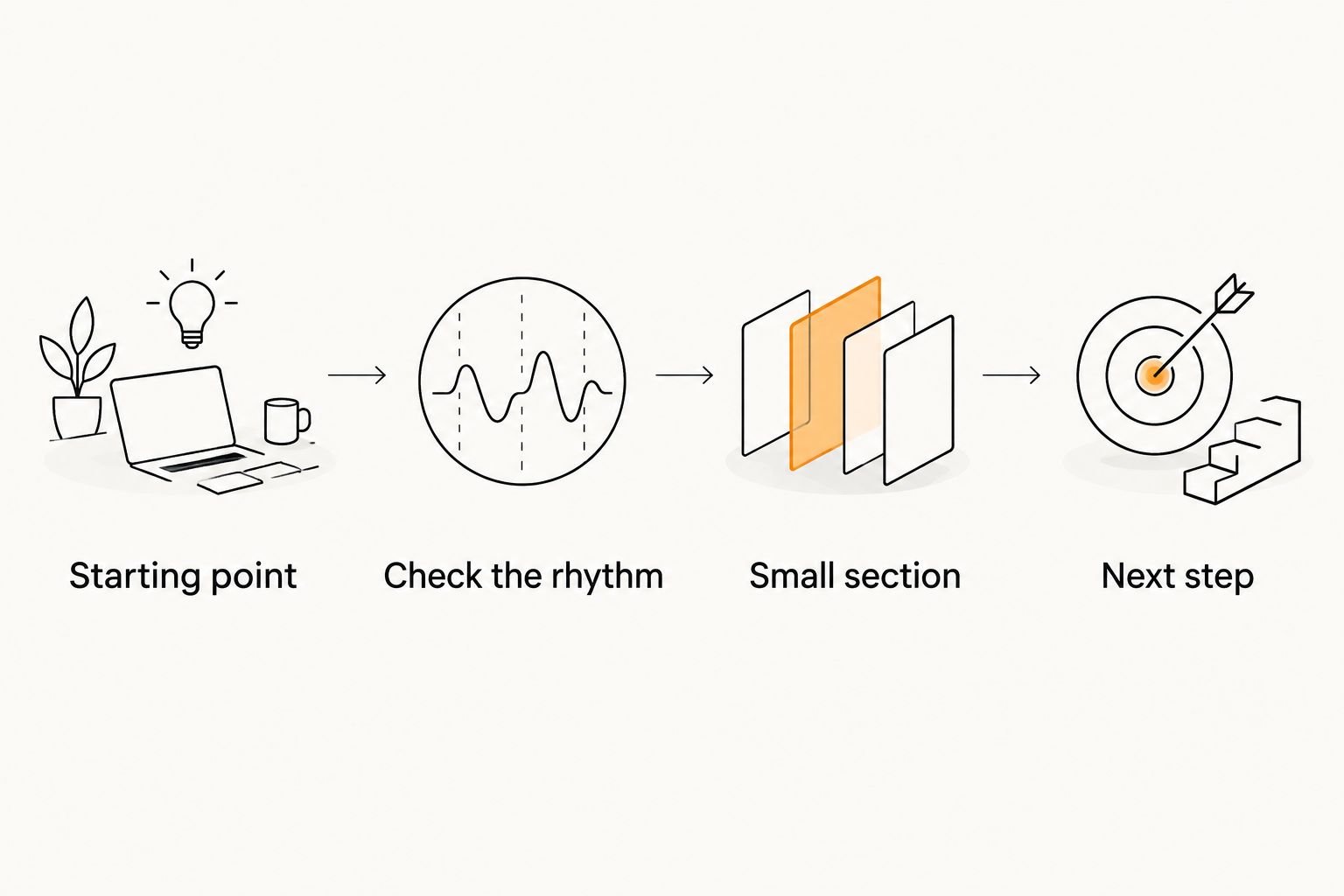
Separate the task into parts so your child knows what to work on.
Growing independence does not mean no parent involvement. A beginner can still need reminders, help understanding instructions, and encouragement after a frustrating attempt.
Keep the routine workable alongside school, soccer, basketball, and family life. If practice repeatedly breaks down, bring the specific difficulty to the teacher rather than assuming your child needs a longer assignment.
What should I ask before choosing beginner piano lessons?
For Huntington Beach families seeking technology-supported beginner piano lessons, Eric's Piano School offers Piano Express for children ages 5+. A free trial is a chance to see the feedback and practice approach rather than judge it from a timeline alone.
Ask the teacher to demonstrate:
What an early reading assignment looks like.
How a child knows what goal to work toward.
What feedback is available between lessons.
How the teacher checks understanding before advancing.
What support a parent should provide at the beginning.
Also ask how the program adjusts when a child needs longer. A clear explanation should connect the two-year pathway with your child's starting point, not turn a school-reported comparison into a personal guarantee.
See how purposeful practice works
Try a free class and ask how Piano Express builds reading skills, provides feedback, and supports your child's next step.
FAQ
How long does it take for a beginner to learn to read music?
First reading skills develop during beginner study; completing elementary studies is a broader milestone. Eric's Piano School reports about two years for its Piano Express pathway to RCM Level 1 proficiency, compared with about five years in its traditional-private-lesson comparison.
Does my child need two years before they can read any music?
No. The two-year comparison concerns completing Piano Express and reaching RCM Level 1 proficiency, not the first time a child recognizes or plays written notes.
Why does Piano Express support faster progress?
The school attributes progress to better engagement, goal-driven practice, and technology-supported feedback between lessons. Teachers continue to guide learning; the tools support practice rather than replace instruction.
How much music do students complete each week?
The school reports 10–20 pages weekly in its program versus 1–2 pages in the traditional environment it describes. Pages differ in difficulty, so these figures are not standardized measures of reading proficiency or individual quotas.
Is the five-year private-lesson timeline a research finding?
No. It is the school's experience-based comparison, not an independently established industry average. Private teachers, students, and the support available between lessons vary.
Does finishing Piano Express mean passing an RCM exam?
The endpoint discussed here is completing Piano Express and reaching RCM Level 1 proficiency. It does not establish that a student has sat or passed an examination.
Will every child complete the program in two years?
No. Two years is the school's reported pathway, not a guaranteed completion date. Individual readiness, practice, attendance, and support needs affect progress.
One last thing
Ask a prospective teacher what happens after your child makes a mistake at home. Who or what helps them notice it, understand it, and decide what to try next?
That question gets to the heart of this article. The difference is not simply two years versus five; it is the quality of the learning that happens between lessons.
